


THE PAINTERS' PRINTS

Published by Julieta Oganado on April 17, 2026
It's not so common to see an exhibition that actually documents a way of working. The Painters' Prints isn't organized around a theme or an obvious aesthetic affinity, but rather
something more difficult to exhibit: a sustained dynamic among four artists who decided to continue working together after a residency. The Painters' Prints, presented at Espacio
Vitriol on April 16, 17, and 18, 2026, brings together Annette Werndl, Guillermo Bublik, Claudia Hassel, and Leonard Gabriel, four artists who met in 2022 during a residency at Mana Contemporary in Jersey City and who have since decided to turn that initial coincidence into a sustained dynamic. After repeating the experience in San Miguel de Allende in 2024 and Cape Town in 2025, the group arrived in Buenos Aires to work together again, this time with a specific focus on learning printmaking and with a final exhibition as a form of provisional closure.

The most interesting aspect of the project isn't just the visible result, but the persistence. The current ecosystem often envelops residencies in an aura of exception, almost as if they were a fertile pause between "real" jobs, but here something else emerges. The residency as a demanding routine. As a structure. As deliberate repetition. It's not just about changing cities to see what happens with color or light, but about building a way of working among peers, a continuity made of time, coexistence, exhaustion, observation, and conversation. The exhibition reveals that. Not the postcard image of Buenos Aires, but he productive toll of long days, of decisions that aren't resolved quickly, of technical tests, and of a learning process that happens through the body before it happens through ideas.
That point structures the reading of the works. If anything unites the four artists, it is color, but not as neutral ground. In Werndl's work, color propels the painting toward an almost sonic intensity, with layers that overlap, scrape, and reapply until the surface never seems to fully stabilize. In Hassel's, on the other hand, color becomes a system. It is organized into planes, adheres to a stricter economy, and constructs spatial relationships where every decision seems to have been scrutinized multiple times. If in one there is expansion, in the other there is control.

Bublik operates on a different level. His work doesn't rely on anecdote or gesture, but rather on a persistent questioning of form and its conditions of emergence. There's something in his painting that doesn't seek to represent the world but to consider how it's organized. In the conversation, a recurring image emerged: that of an origin, an initial state where everything was contained within a single mass and where, at some point, that continuity fractures. Line and geometry then appear not as an imposed order, but as the result of rupture. As if each form still carried the memory of a larger system that no longer exists.
Leonard Gabriel introduces another frequency to the whole. While Bublik pushes toward patterns and structures, Gabriel returns the scene to the scale of the body. His figures do not strive for academic precision or descriptive virtuosity. What matters is the slightest gesture, the inclination, the tension in a posture—that ambiguous zone where an emotion becomes visible without needing to be explained. There is in his paintings a rather direct trust in the ability to recognize in another something that has already been experienced. Not as sentimental identification, but as bodily memory.
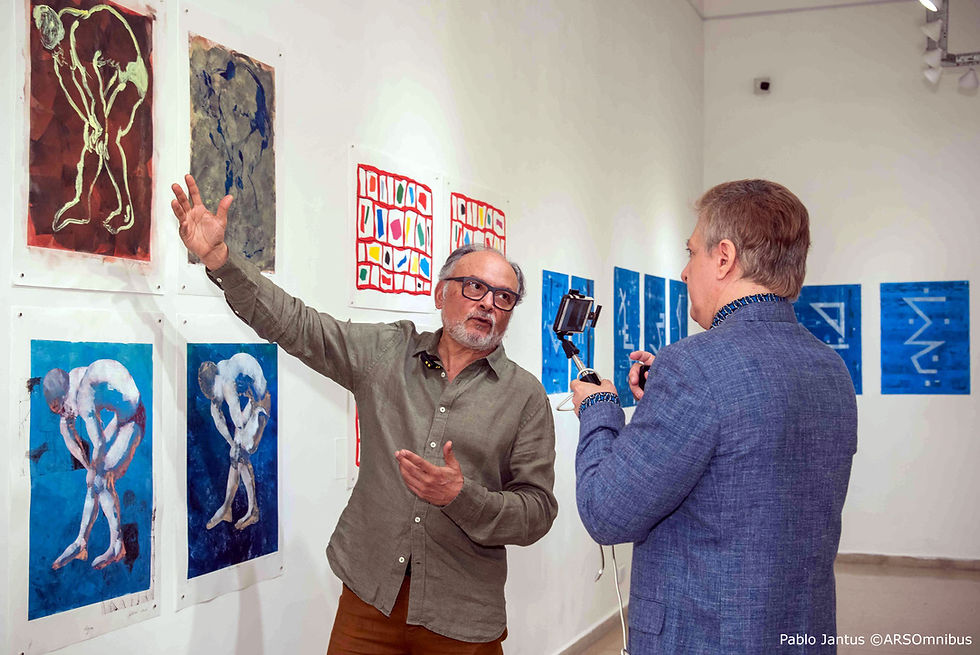
At this crossroads, the exhibition works best when read as a system of translations rather than as a sum of individual languages. It's not about erasing differences or celebrating diversity as a slogan. What emerges is a circulation. Werndl takes color toward matter and intensity. Hassel reduces it until it becomes structure. Bublik stretches it into problems of form and rupture. Gabriel uses it to imbue the figure with affection. This coexistence doesn't dilute singularities; it makes them more precise. Each artist seems to adjust their practice in relation to the others.
There's also something valuable in the way Buenos Aires enters the equation. Not as a theme, nor as a repertoire of recognizable signs, but as a working condition. Instead of absorbing the city as an image, the group decided to engage with it through technique.
They came to learn printmaking. To subject the practice to a process. This shift changes everything. The city ceases to be a backdrop and becomes an operational context. A place where something is learned, tested, and sustained over the duration of the residency. Instead of extracting a quick local color from it, they used it as a workshop.

There is also a dimension that shouldn't be overemphasized but which underpins the whole. These residencies are not an isolated episode within an individual's trajectory. They are a recurring decision. What began as a shared experience within an institutional framework has transformed into an autonomous practice that is reinvented in different locations. This involves logistics, time, money, and energy. It involves persistence when there is no guarantee of success. Here, a less rhetorical version of "networks" and "community" emerges—not as a concept, but as a sustained practice.
It's also worth reading this insistence within a broader context. In an art system increasingly accustomed to rapid circulation, to networking spoken of quietly but practiced openly, these recurring artist residencies recover something less marketable and considerably more arduous: the construction of a shared temporality. They don't come together just to exhibit. They come together to work. It seems obvious, but it isn't. In a scene that often rewards visibility over substance, deciding to retreat again to produce, to learn a technique, and to subject the practice to daily scrutiny has something subtly countercultural about it.
That doesn't mean the exhibition is homogeneous or that everything functions with the same intensity. Precisely because the structure is strong, it reveals differences. There are moments where the narrative of the residency carries more weight than some specific resolutions. But this unevenness doesn't weaken the whole. On the contrary, it makes it more legible as a process. It strips away the layer of perfection that many exhibitions need to function and reveals something more uncomfortable but also more real: the work in progress.
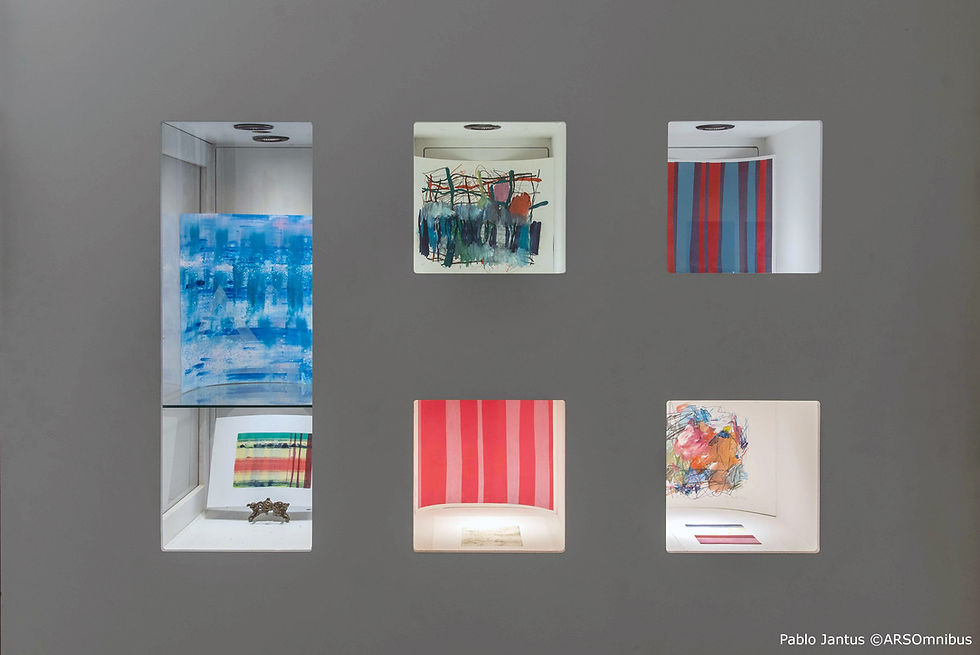
And therein lies its greatest difference from so many closing exhibitions. The Painters' Prints doesn't take refuge in the meticulousness of the result, nor in the small international backdrop of four careers brought together by chance. When it works, it works because it allows the process to be seen without fetishizing it. It doesn't sell perfect harmony. It exhibits a coexistence of languages, rhythms, and obsessions that sometimes fit together and sometimes don't quite. This lack of total polish doesn't work against it. It saves it from becoming a merely adequate showcase.
What remains, then, is not just a collection of works, but a practical thesis on how to sustain artistic production without surrendering it entirely to either the isolation of the studio or the empty sociability of the art circuit. The Painters' Prints is worth less for the promise of a closed group identity than for the still-open evidence of a working alliance. And on that point, it hits the mark completely. Not because everything is resolved, but because it reveals something that doesn't always appear clearly in contemporary art: that the dynamics of working also produce form.

Article courtesy of ART in Caps


Comments